Direction par Horizon is designed for construction businesses that want to connect quotes, projects, purchases, time entries and billing in monday.com. Horizon Nord provides a management foundation built around these workflows, then adapts it to the company's processes and responsibilities. The offer uses monday.com Enterprise and includes customization and team training.
The decision depends largely on what your records need to connect. A focused configuration may cover an isolated process. When each purchase order must feed a budget, and hours must support both job costs and billing, the connections between modules become more valuable.
What Direction adds to the platform
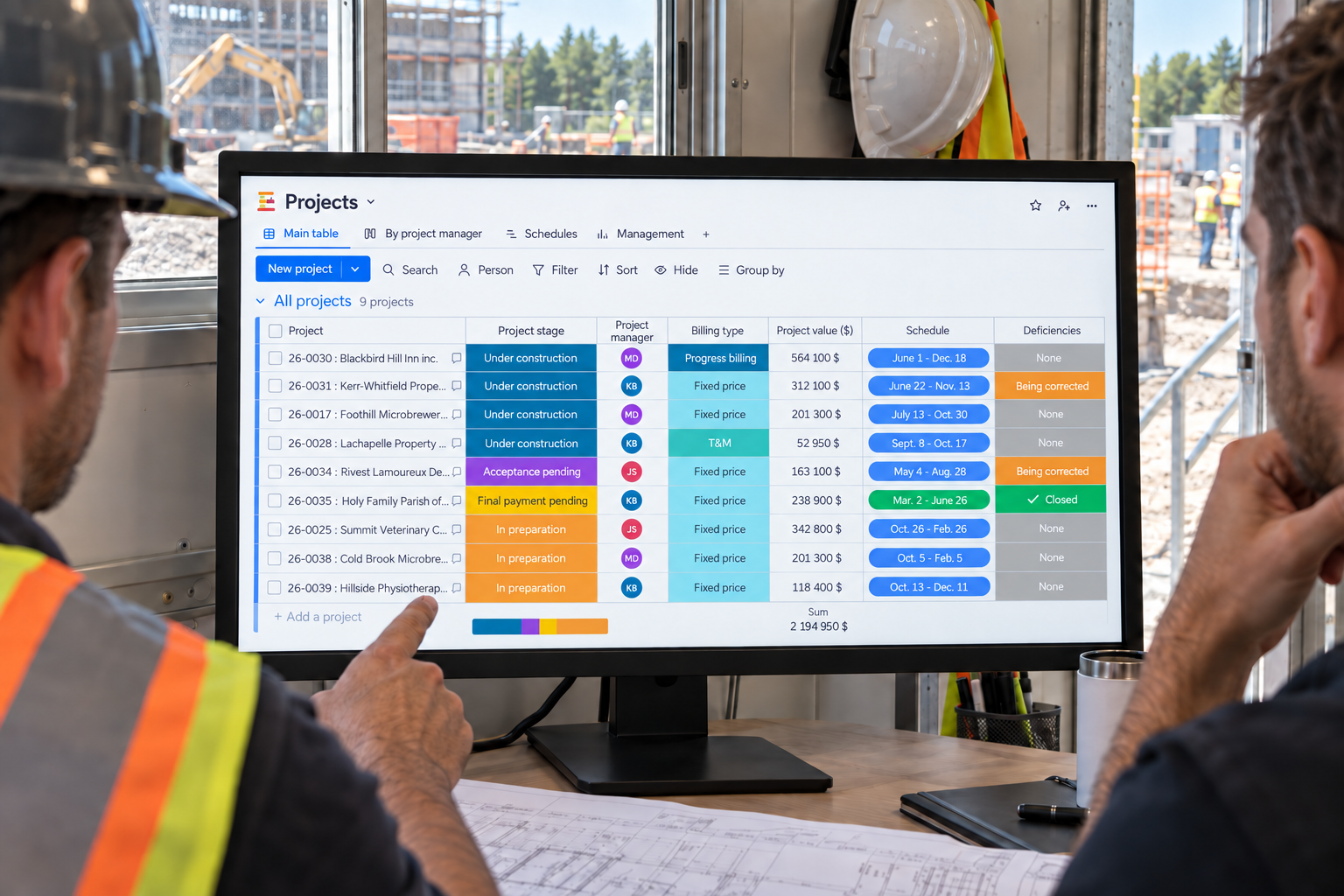
monday.com provides the platform. Direction adds a foundation of construction processes with connected modules, documents and automations. Implementation adapts roles, approval rules, cost codes, forms and operational views to the company.
That foundation should be evaluated through a complete record. A purchase order needs to retain its lines and conditions. The supplier's invoice needs to reach the correct job. Approved hours need to feed the relevant cost code. The practical value lies in maintaining those connections throughout the work.
The workflows worth demonstrating
Budget visibility before all invoices arrive. A confirmed purchase order reduces the available amount. The Budget module brings orders, invoices, labour and materials together. Ask to find the expense that explains a variance.
Approval with supporting records. The Accounts Payable module keeps the invoice and prepares its information for review. The office checks the allocation and requests approval. Document requirements can affect that decision. Ask what the responsible person sees when a required document is missing.
Billing that follows the contract. The Billing module covers time and materials, fixed-price instalments and progress billing. Ask to see the method you use, including its period, previously billed amounts and payment tracking.
These workflows let you assess solutions against decisions your team actually makes. A feature list alone does not show how information moves between the field, the project manager and the office.
A focused configuration, Direction or a broader financial project?
A focused monday.com configuration is worth considering when the requirement is a clearly defined process and you have people available to design and maintain it.
Direction becomes relevant when you want a common foundation for several construction processes, with support to adapt them together. Implementation can begin with priority modules and grow according to the business's needs.
If the main objective is replacing accounting, payroll or a financial ERP, those requirements need separate evaluation. Direction can connect with the accounting software you retain; its operational modules do not by themselves demonstrate coverage for a complete financial replacement. Our guide to Direction with QuickBooks Online, Acomba or Sage explains that division of work.
For any specialist solution under consideration, request the same examples: an amended purchase order, a partial invoice, hours requiring correction and an accepted change in scope. Compare the steps, responsibilities and information available against your own criteria. This creates a useful comparison without assuming that every construction business needs the same system.
Is Direction suitable for a small construction business?
The fit depends on the workflows you need to connect. If purchase orders, invoices and timesheets move between separate files, Direction par Horizon can bring them together by project. You can start with your priority modules. The proposal specifies users, monday.com Enterprise subscriptions and implementation.
What determines implementation cost and effort
The proposal depends on users, selected modules, data to bring across, documents to adapt and the support required. It should distinguish subscriptions, implementation services and support during rollout.
The work includes needs analysis, customization, workflow validation and training by role. Your business also needs people who can validate rules and data. Without that participation, even an adapted foundation can remain difficult to use day to day.
Define the first scope around a result your team can verify: for example, tracing an approved invoice to its purchase order and budget code. Broader deployment can then use the decisions and working practices established during that initial scope.
Bring a real requirement to the demonstration
Choose a representative job and prepare examples of a contract, purchase order, supplier invoice and time entries. The documents can be anonymized. Explain where information is currently lost and who needs to make the next decision.
Then ask to follow that record through Direction par Horizon. Check the superintendent's, project manager's and administrator's actions, along with the information each can retrieve. This gives you a concrete basis for deciding whether the system fits your business and for defining an initial implementation scope.
