

The morning follow-up
A project manager opens several boards, messages and documents to reconstruct what is blocked before the meeting. Who gathers all of that before 7 a.m.?
Your operations system already lives in monday.com. We configure one simple agent to prepare a precise, repetitive task, with a clear role and a responsible person for every decision.
One simple agent and one clearly defined process, configured and tested in your existing monday.com environment.
 Construction and building supply
Published pricing, bounded scope
Construction and building supply
Published pricing, bounded scope
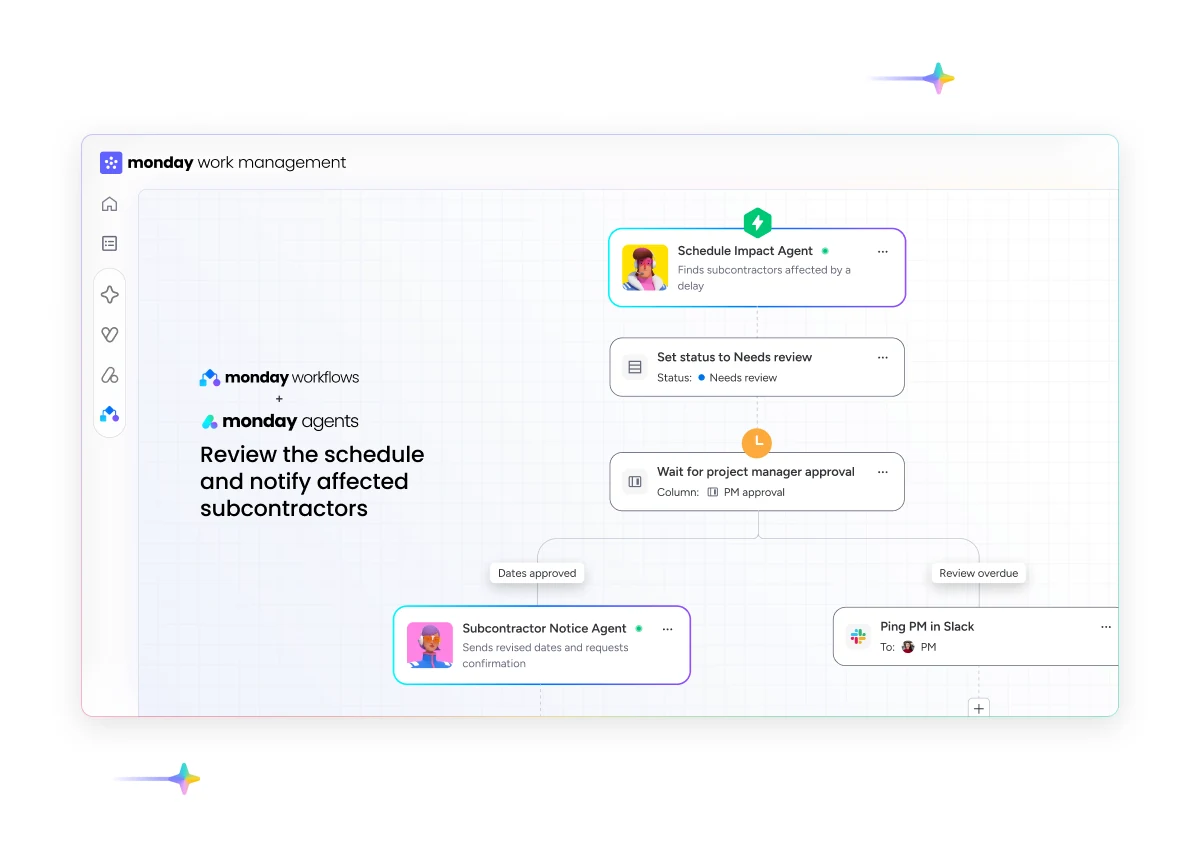
The missing piece is not monday.com. It is the time spent each day rebuilding context the system already contains.
A project manager opens several boards, messages and documents to reconstruct what is blocked before the meeting. Who gathers all of that before 7 a.m.?
The document arrives, but the right job, owner and approval still have to be found by hand. Who matches it to the right file today?
Plans, past prices and pending answers exist, but nobody has gathered the context needed for the follow-up. Who prepares the file before the deadline?
Bernard, Diane, Nora and Sam are illustrations. Your agent is configured around your process, vocabulary, access and limits. The offer is custom agents, not a character catalogue.

He reads: the schedule boards, reports and project messages in his mandate.
He prepares: the morning update, with blockers, delays and follow-ups to review.
You decide: the priority, the commitment to the client and the answer that goes out.
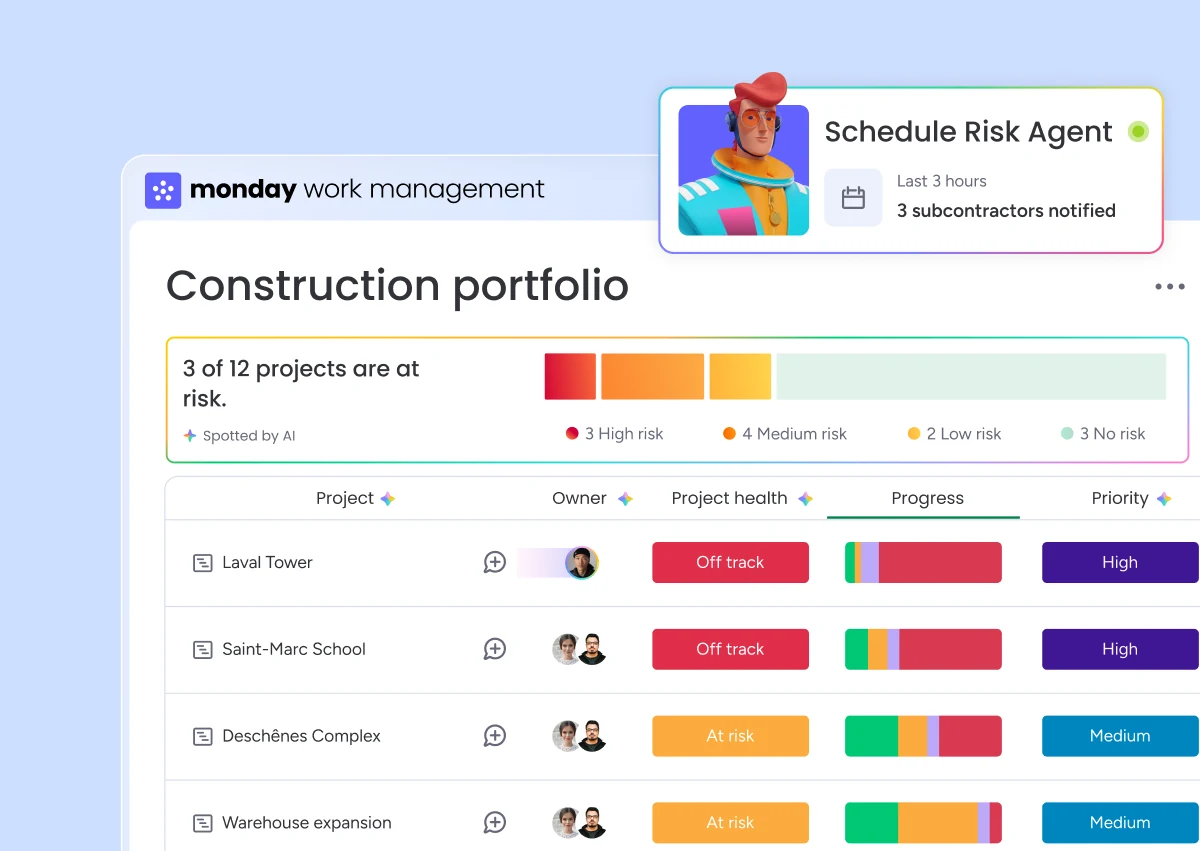
monday.com interface: the portfolio shows at-risk jobs, progress and who answers for each file.

She reads: the incoming invoice and the authorized project boards.
She prepares: the match with the right job and the approval request.
You decide: the approval and the payment.


She reads: the files, plans and certificates in scope.
She prepares: the list of what is missing before the file gets blocked.
You decide: what to request, from whom and when.


He reads: the incoming request, the plans and the prices from previous files.
He prepares: the file context and the follow-ups your team needs to review.
You decide: the price, the margin and the send.

The agent consults only the boards, columns and documents named in its mandate. Nothing else.
Every agent output has a person who answers for it. Approvals, prices and commitments stay with your people.
What the agent prepares lands in your boards, where your team sees it, corrects it or rejects it.
The role, the access and how to deactivate it are documented at handover. Your team keeps the wheel.
The price covers a bounded result. You know which process is targeted, what the agent can prepare and where your team takes over.
Choose one simple, repetitive process that genuinely merits an agent.
Define the role, authorized information and expected output in monday.com.
Run the agent on real work and correct what needs attention.
Train the team and document operation, access and human responsibilities.
Additional agents, redesign of other processes, data cleanup or migration, more than one simple external connection, monday.com licences and ongoing changes after handover.
Those needs are scoped separately so the first engagement stays clear.
One scoping call is enough to know whether your process qualifies.
Every case follows the same rule: the agent prepares, a named person decides. Yours is not on the list? That is exactly what the 30 minutes are for.
Morning update Blockers, delays and follow-ups gathered before the meeting.
Field reports Daily reports compiled to the right project.
Subcontractor notices Notices prepared after a schedule revision.
Supplier invoices The invoice matched to the job, ready for approval.
Planned versus actual cost Gaps flagged while there is still time to act.
Timesheets Missing or inconsistent hours spotted.
Incoming requests The file opened with plans, contacts and context.
Follow-ups Reminders prepared and ready to review before sending.
Comparables Prices from previous files found and gathered.
Missing items The list of what blocks a file, prepared ahead.
Certificates and insurance Upcoming expirations flagged in time.
Deficiencies and warranties End-of-project follow-ups prepared.

A former construction business owner, Guillaume separates a process simple enough for a first agent from one that needs better architecture first. That decision protects both budget and delivery quality.
monday.com first, then the systems that matter: when the process extends beyond monday.com, we can connect one useful source such as accounting software, the field system or another approved tool. The first engagement stays intentionally simple. Broader connections belong in the complete system.
Three ways to work together. Precise quantities (boards built, working sessions) are set in writing at scoping.
| First agentStarting at CA$5,000 | Operations systemStarting at CA$16,500 | Ongoing supportCustom quote | |
|---|---|---|---|
| Processes covered | 1, clearly defined | Several, prioritized together | Ongoing, as your needs evolve |
| AI agents configured | 1 simple agent | The relevant agents | New agents as needed |
| monday.com architecture | Your existing environment | Redesigned and built | Evolved over engagements |
| External connections | 1 simple connection if needed | The approved systems that matter | Per engagement |
| Tests on real work | Included | Included | Included |
| Team training | Included | Included | As needed |
| Documentation and handover | Included | Included | Included |
| Named human owner | Included | Included | Included |
| After delivery | Optional bank of hours | Optional ongoing support | Banks of hours and new engagements |
Prices in Canadian dollars. Targeted support: 25 hours at $225/hour, 50 at $200/hour, 100 at $185/hour, or 200 at $165/hour.
The first agent should be small, useful and understandable by your team.
Book 30 minutesYes. The first engagement starts from an existing monday.com environment and a process clear enough to configure a first simple agent.
One simple agent on a defined process, configured in your monday.com, tested on real work, then handed over with training and documentation.
No. It gathers context, prepares a follow-up, flags an exception or routes a request. Commitments, approvals and priorities stay with the responsible people.
Only the information and boards authorized in scope. Access, the agent's role and the person responsible for decisions are defined before configuration.
The engagement is scoped to stay short: one process, one configuration, tests on real work, then handover. The exact duration depends on the chosen process and is confirmed on the scoping call.
The list shows common construction examples. If your process is repetitive and clear enough to describe in a few sentences, it probably qualifies. The scoping call exists to verify exactly that.
Your team can keep the agent as delivered, request adjustments through a bank of hours or expand the engagement to an operations system and additional agents.
In 30 minutes, we determine whether the process is simple enough and useful enough for a first engagement.
Prefer a new window? Open Calendly.