
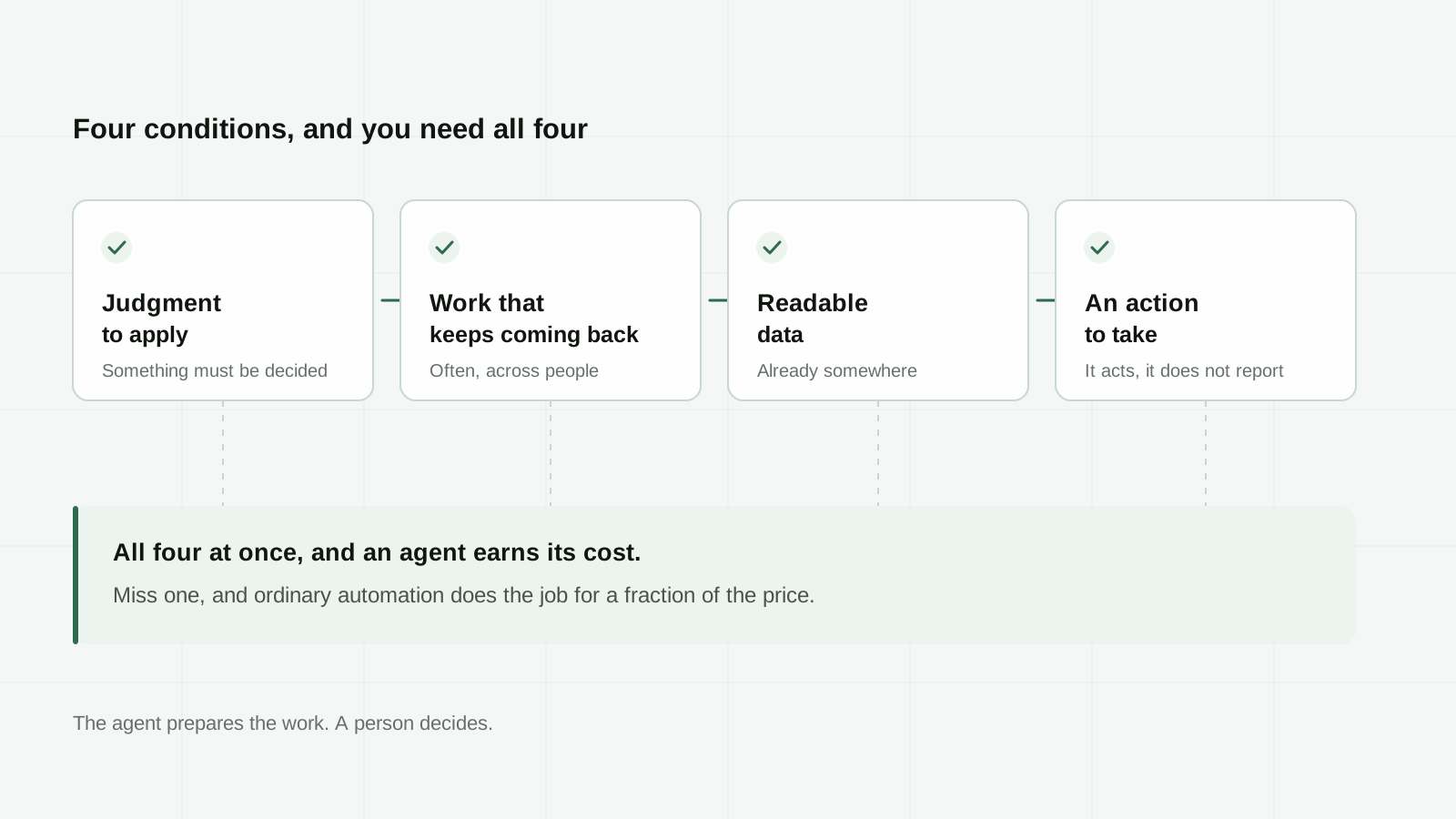
Before you pay for an AI agent, four conditions have to line up: the task requires judgment, it comes back often, it runs on data you already have, and it ends in a concrete action. Miss a single one and ordinary automation does the work for a fraction of the price.
What this article covers: why most AI budgets produce nothing measurable, the four conditions that separate a real agent use case from a bad one, and what to do when one of them is missing.
There is a line item showing up at a lot of construction contractors right now. An AI budget, released because there had to be one, committed to a project that nobody, six months later, can say changed anything.
That is not just an impression. An MIT study published in July 2025, *The GenAI Divide: State of AI in Business 2025*, run by the NANDA project, reviewed more than 300 publicly disclosed AI initiatives, ran 52 executive interviews and collected 153 responses from senior leaders. Its most quoted finding: the vast majority of generative AI pilots produce no measurable impact on the bottom line.
The same study draws a second conclusion, less commented on and more useful. In their sample, tools that came from an outside partner, built to learn and fitted to the real workflow, reached deployment about two times in three. Tools built in house, about one time in three. The authors note these are self-reported outcomes, but that the size of the gap held across every leader they interviewed.
The word carrying that sentence is not "outside." It is "fitted to the real workflow." A partner changes nothing by simply being there; what changes something is a tool cut for the work as it is actually done.
So the difference is not the AI model. It is the question you ask before you start.
Here are the four. They come from the monday.com Agentic Leaders Program, where they are used to qualify a use case before anyone builds it. We also use them the other way around: to tell someone they do not need us.
Does the task require judgment?
An agent reads, thinks, then decides. If the task comes down to "when this happens, do that," there is nothing to judge, and ordinary automation will do the work for a fraction of the cost.
What passes: deciding whether a subcontractor’s certificate of insurance actually covers the site you are assigning them to. Someone has to read a policy, understand its scope, spot what is missing, and decide whether it blocks mobilization.
What fails: sending an email when a form is submitted. Nobody ever had to think in order to do that.
Does it come back constantly and eat time?
An agent costs something to design, and it only pays for itself on repetition. So the right way to measure is not "how long does it take" but "how many times a week, times how many people."
What passes: work order follow up. Ten minutes each time, forty times a week, three project managers. Twenty hours a week between them.
What fails: the month end reporting exercise. Two days of work, twelve times a year. Heavy every time, and too rare to pay back a design.
Does it run on data you already have?
This is the question that kills the most projects, and it almost always shows up after the contract is signed. An agent can only decide from what it can read. The data does not need to be perfect, it needs to exist somewhere a system can reach.
What passes: hours, purchase orders and invoices that already live in monday.com, in an ERP, or even in one shared file. Imperfect, but reachable.
What fails: the price negotiated with a supplier, known only to the project manager. Or three files that give three different totals for the same site. There, the AI project becomes a data cleanup project first, and that is not what you budgeted for.
Does it have to take an action?
An agent that produces a report nobody reads has replaced one task with another. The value shows up when it acts: it assigns, it follows up, it blocks, it escalates to the right level. This is also where the only real governance question sits, and here that rule does not move: the agent prepares the work, a person decides.
What passes: blocking the mobilization of a subcontractor whose insurance certificate has lapsed, and escalating the file to the superintendent with what is missing.
What fails: producing one more weekly dashboard. The work changed hands, it did not shrink.
And if the answer is no to just one of them?
Then you do not need an agent.
You might need a simpler automation, with its cost compared against the work it would handle. You might need to put a data source in order before anything else. You might simply need to stop doing the task, which happens more often than you would think once you look at it closely.
All four at once, then there is something there. And that is the point where an AI budget turns into an investment rather than a line to justify.
These four questions get answered in one meeting, with the people who do the work. You do not need anyone for that. If all four answers are yes and you want to see what the next step would look like, that is where we can help. Our AI agents page covers how we build them, a companion article explains how to add agents without changing platforms, and in construction companies the first finding is almost always the same: the information already exists, it is just scattered. Let’s discuss your operations.
Frequently asked questions
What is the difference between an AI agent and an automation?
An automation runs a fixed rule: when this happens, do that. An agent reads information, interprets it and decides what comes next. The practical test is judgment. If there is nothing to judge, an automation does the job for far less money.
How long does it take for an AI agent to pay for itself?
An agent pays for itself on repetition, so the useful measure is how many times a week, multiplied by how many people are involved. A ten minute task done forty times a week by three people weighs more than a two day task done once a month.
Does our data have to be perfect before we start?
It has to be readable by a system, which is different from being perfect. If the information lives in a superintendent’s head or in three files that contradict each other, the project starts with a cleanup. That is useful work, but it belongs in the budget.
Can an AI agent decide instead of our people?
At Horizon Nord the rule does not move: the agent prepares the work, a person decides. An agent that takes an action needs a written line between what it does on its own and what it hands to someone.
