
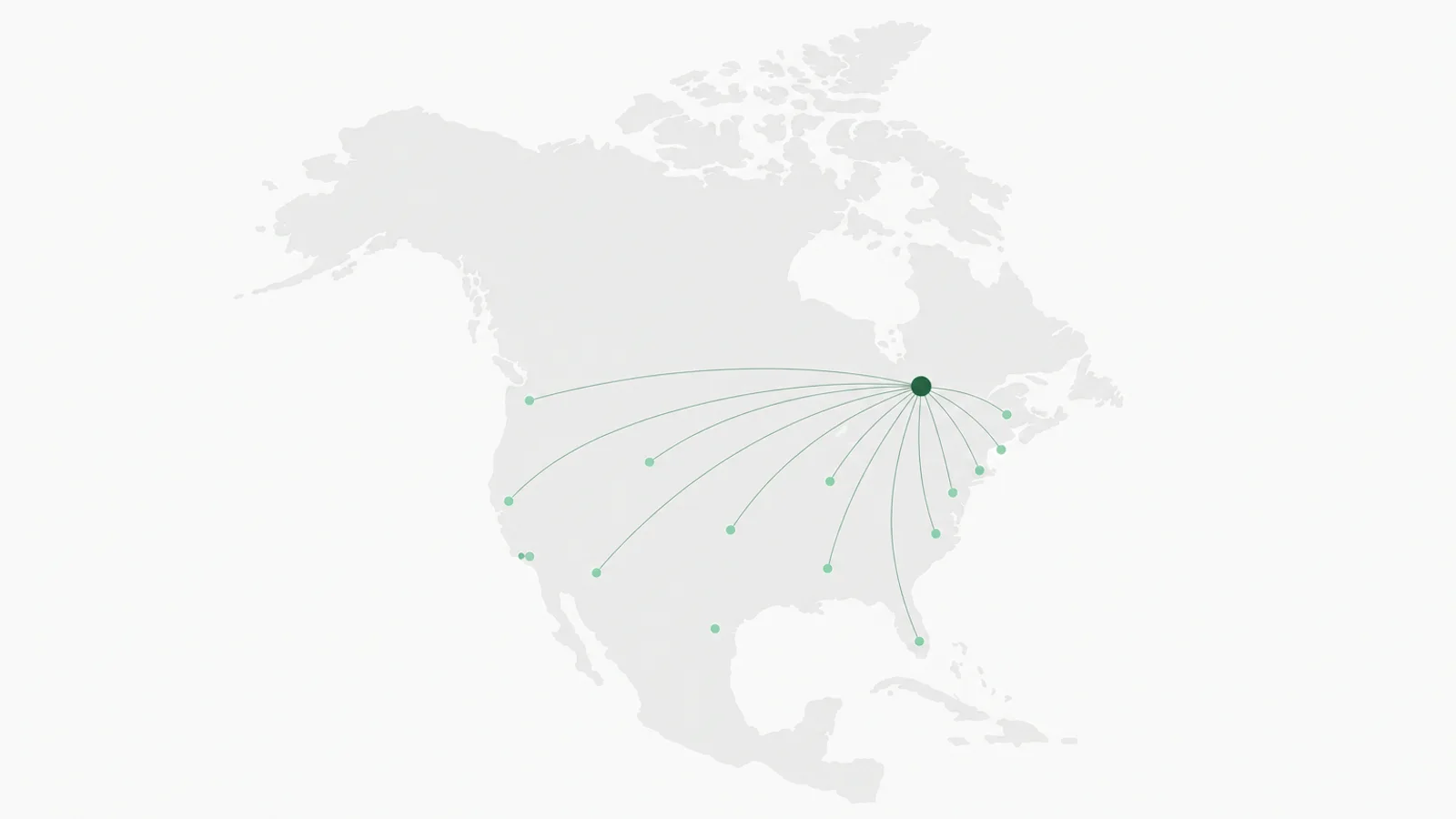
Horizon Nord is a monday.com certified partner based in Quebec. Construction is our primary specialization: general and specialty contractors, construction project teams and real estate developers. We also work with construction materials and component manufacturers, suppliers and distributors serving their projects across Canada and the United States, in English and French.
What this article explains: who Horizon Nord serves in the United States, what we build there, and why North American operations experience matters in construction and in the companies manufacturing, supplying or distributing its materials.
If you run operations for a US contractor, construction materials manufacturer, supplier or distributor and you landed here, you probably noticed something: a good part of our content is in French. We are a Quebec agency, and Quebec is our home market. But monday.com systems do not stop at the border, and neither do the problems we solve. The gap between the jobsite, plant, warehouse and office looks the same in Ohio as it does in Ontario.
Who we are, stated plainly
Horizon Nord is a certified monday.com partner agency. Our primary specialization is construction. Our second vertical follows the same supply chain: construction materials and component manufacturers, building suppliers and materials distributors. We work in English and French, often in the same company and sometimes in the same meeting.
We are based in Quebec. We do not have a US office, a US subsidiary, or a shared desk somewhere with our name on the door. What we have is a delivery model that was remote-first long before it was fashionable, clients we serve entirely in English, and a time zone that lines up with the entire eastern half of the continent. For a US company, working with us looks like working with any sharp consulting firm in your own time zone, with one difference: the person on the call is the person who configures your boards.
What we build for US companies
The starting point depends on the work you need to connect and the tools your team already uses.
Direction by Horizon for construction
Direction by Horizon provides an existing management system built in monday.com: bids, projects, budgets, purchase orders, time entries and billing. Horizon Nord adapts its modules, responsibilities and approvals to your company, then supports your team as they use it.
Horizon Clock for mobile time tracking and OCR by Horizon for supplier invoice extraction are available exclusively with Direction by Horizon. They prepare data your team reviews in the Time Entries and Accounts Payable modules.
A monday.com implementation shaped around your operations
For a requirement specific to your team, a monday.com implementation connects the processes you need: production tracking, orders, documents or delivery. For manufacturers, suppliers and distributors, the ERP or MRP remains the official source for stock and costs; monday.com coordinates owners, dates and exceptions.
AI where it can prepare useful work
Sidekick, monday workflows, agents and connections such as Claude can be added where needed. An agent might identify bids with no recent activity and prepare follow-up drafts. Your project manager checks the facts and decides whether to send them. Our AI automation page explains how the scope and controls are defined.
Why North American operations experience matters
Any partner can learn monday.com's feature list. What matters here is understanding how a bid becomes a project, and how a materials order moves through production, warehouse and delivery. That is the continuity we bring into monday.com.
The job-site to office gap is the same everywhere
A superintendent scribbles quantities on a printed sheet. The office retypes them three days later. At the manufacturer or distributor, a drawing revision arrives after the order has entered preparation. These companies share the same problem: keeping the right information connected between the jobsite, plant, warehouse and truck. monday.com becomes the shared order file where everyone can see the commitments.
Bilingual teams are an operations reality, not a luxury
US companies near the border, and plenty of them much further south, run mixed crews: an English-speaking office, Spanish or French-speaking foremen, suppliers on both sides. Canadian companies expanding into the US live the mirror image. We build systems where the same board serves an English-speaking project manager and a French-speaking site supervisor without either one becoming the bottleneck. When your operations cross the border, your system should not notice.
Cross-border operations need one source of truth
A Quebec construction component manufacturer shipping into the US, or a US contractor with Canadian suppliers, lives the same pain: two sets of tools, two sets of statuses and a weekly meeting to reconcile them. A properly built monday.com system gives both sides the same live board, the same statuses and the same documents.
What working with a Quebec partner actually looks like
Concretely: video calls in your time zone, boards and documentation in English, a named person who does the work, and on-site visits when the mandate justifies the travel. Implementation work is screen work; the rare moments that need a physical presence, like a plant floor walkthrough, are planned, not improvised.
Contracts are in English. Support requests get answered in the language they were asked in. None of this is exotic: it is how we already work with our English-speaking clients across Canada.
What we deliberately do not claim
No US office, and no plan to pretend otherwise. Quebec is a feature: a lean structure, senior people on every mandate, and a team that learned operations in one of the most demanding construction markets on the continent.
No invented US case studies either. The scenarios in this article are mechanism examples, illustrations of how the system works, not client results. When we publish numbers, they will come from real mandates, with the client's permission. That standard costs us some flashy headlines, and it is not negotiable.
And no autopilot promises. If a vendor tells you their AI will run your follow-ups, your pricing and your client commitments by itself, ask them who is liable when it is wrong. In our systems, an agent prepares, a person approves, every time.
A first conversation costs 45 minutes
Whether you are a US contractor tired of chasing bids through a spreadsheet, or a manufacturer whose production status lives in one person's head, the starting point is the same: a 45-minute call, no commitment, in English. We look at how your information moves today, and we name the first process worth structuring, whether you continue with us or not. Discuss your operations.
Frequently asked questions
Does Horizon Nord have an office in the United States?
No. We are based in Quebec and we serve US clients from Quebec, in English: video calls in your time zone, documentation in English, on-site visits when the mandate justifies the travel. We state it plainly because a partner's honesty about where they are tells you a lot about how they will run your project.
Do you deliver in English?
Yes, fully. Boards, statuses, automations, training and documentation are delivered in English or in French, and often in both for the same company. Bilingual delivery is not an add-on for us: it is how we work every week.
What monday.com products do you use for AI?
The native stack: Sidekick for everyday assistance, monday workflows for AI steps inside automations, and AI Agents for autonomous preparation sequences. When a mandate calls for deeper analysis, we connect Claude through the MCP server. In every case, agents prepare the work and humans keep the decisions.
How do we start from the United States?
With a 45-minute call, in English, no commitment. We map how your information moves today and identify the first process worth structuring. If the fit is right, implementation starts with process mapping on your real files, in your team's vocabulary.
