
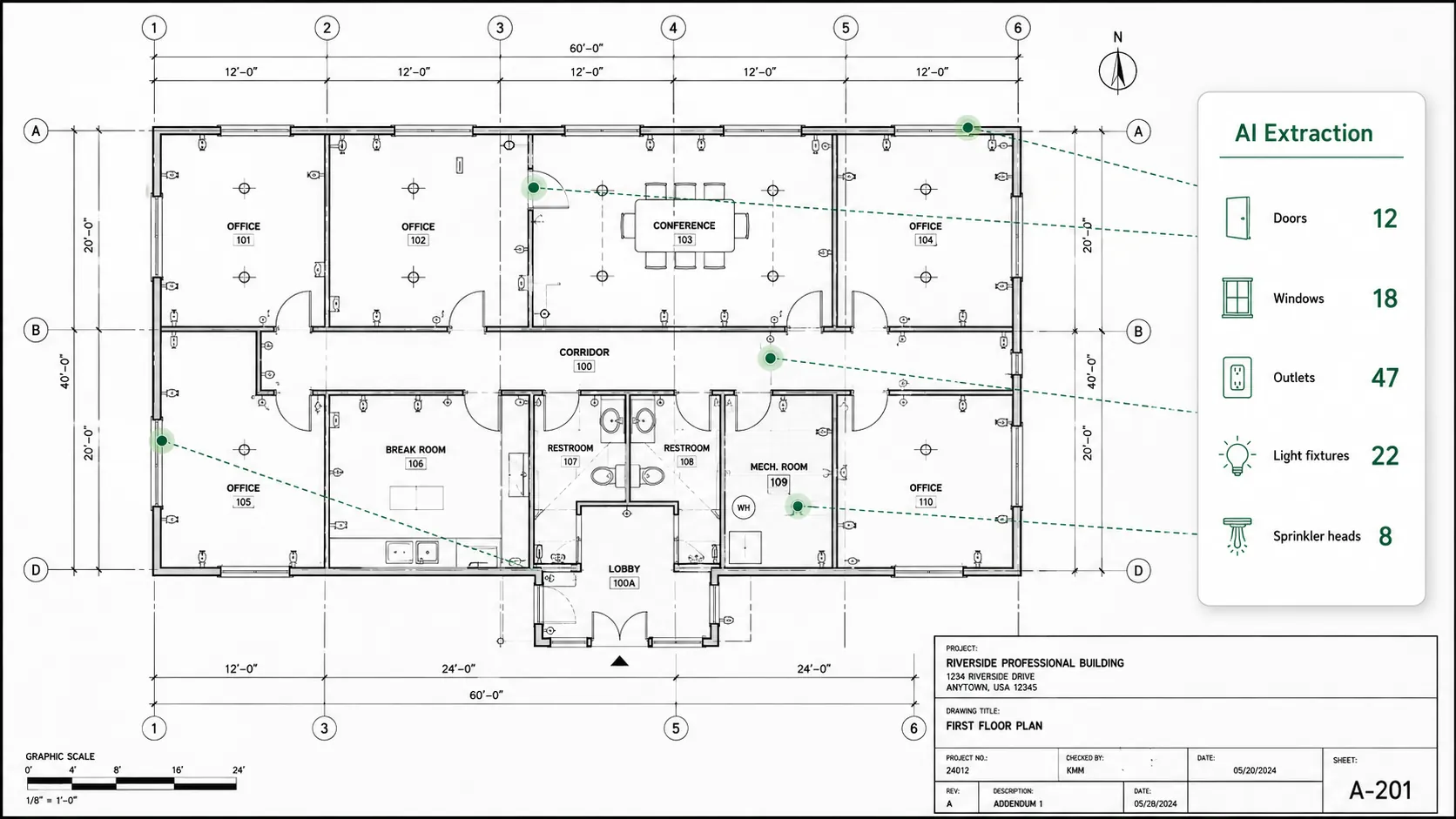
AI blueprint reading can extract tables, notes and preliminary counts, then structure the result in monday.com. It should not produce a final price or validate sensitive quantities on its own. An estimator must check every value that affects a bid or contractual commitment.
The useful question is narrower: which repetitive data can be prepared automatically without delegating technical judgment? Here are reasonable uses, their limits and a controlled pilot method.
What AI extracts well today
Vision models can process several forms of technical documents, but results vary with file quality, layout, scale and supplied context. Three data families offer a reasonable starting point.
Material lists and quantity schedules
A drawing set can include door, window, finish or equipment schedules. AI can turn those tables into structured data for monday.com. Quality must be measured on your own documents before automating downstream use.
General notes and annotations
AI can identify and classify notes on drawings: code references, special requirements and references to specifications. The estimator checks extracted passages against the source page and looks for omissions before using them.
Repeatable countable elements
AI can propose an initial count of repeated symbols such as outlets, fixtures or lights. That output is a worklist to verify, never a final quantity assumed to be accurate.
What AI doesn't do well
Technical honesty means naming the limits.
Measuring linear lengths precisely
AI can estimate, but a contractual measurement requires a confirmed scale, a specialized tool and human validation. Partition, duct and pipe lengths should not be accepted from model output alone.
Reading handwritten or redrawn plans
Field sketches, pencil annotations, shop details drawn by hand: generalist AI gets lost. For those cases, you go back to humans or to a highly specialized OCR.
Understanding sections and 3D details
An elevation, a vertical section, an isometric detail: AI sees the lines, but it doesn't reconstruct the building in its head. It can describe what it sees, not infer what isn't drawn.
A controlled workflow in monday.com
Test this processing chain on a representative sample before any production use.
PDF drops into your project management system
The estimator places the drawing set in the project board. An automation triggers processing, no extra click required.
AI extraction page by page
An authorized agent identifies tables, extracts notes and proposes an initial count of repeated elements. The result lands in monday.com with the source file, page and validation status.
Estimator validation
The estimator opens the board, returns to the source page and validates sensitive quantities. The pilot must measure actual time saved, correction rates and categories that remain too risky.
Transfer to estimating
Only validated lines move into the estimating process. The price and bid remain approved by the responsible people.
Questions to ask before diving in
AI applied to blueprints is not a magic button. Before investing in an automated extraction chain, three questions are worth asking.
Which repetitive work are you trying to reduce?
Measure document volume, preparation time, review cost and current errors. Return on investment depends on this internal evidence, not a universal threshold.
What's the quality of the plans you receive?
Clean vector PDFs from professional architects: excellent ground. Photos of rolled drawings, scanned crooked, with marker annotations: rougher ground.
Do you already have a central system for your projects?
Without a clear destination for the extracted data, AI just produces noise. The value shows up when extraction plugs into your existing process.
The direction to take
Capabilities change quickly, but the control method remains stable: test on your own documents, retain the source page, require human validation and measure corrections.
For today, the right angle is to start with the elements AI already handles well (tables, notes, simple counts), build a chain that delivers part of the estimate, and keep the human in the loop for judgment calls.
This is exactly the kind of project we scope in a first conversation. If you want to see what it would look like with your real plans, let's talk.
