
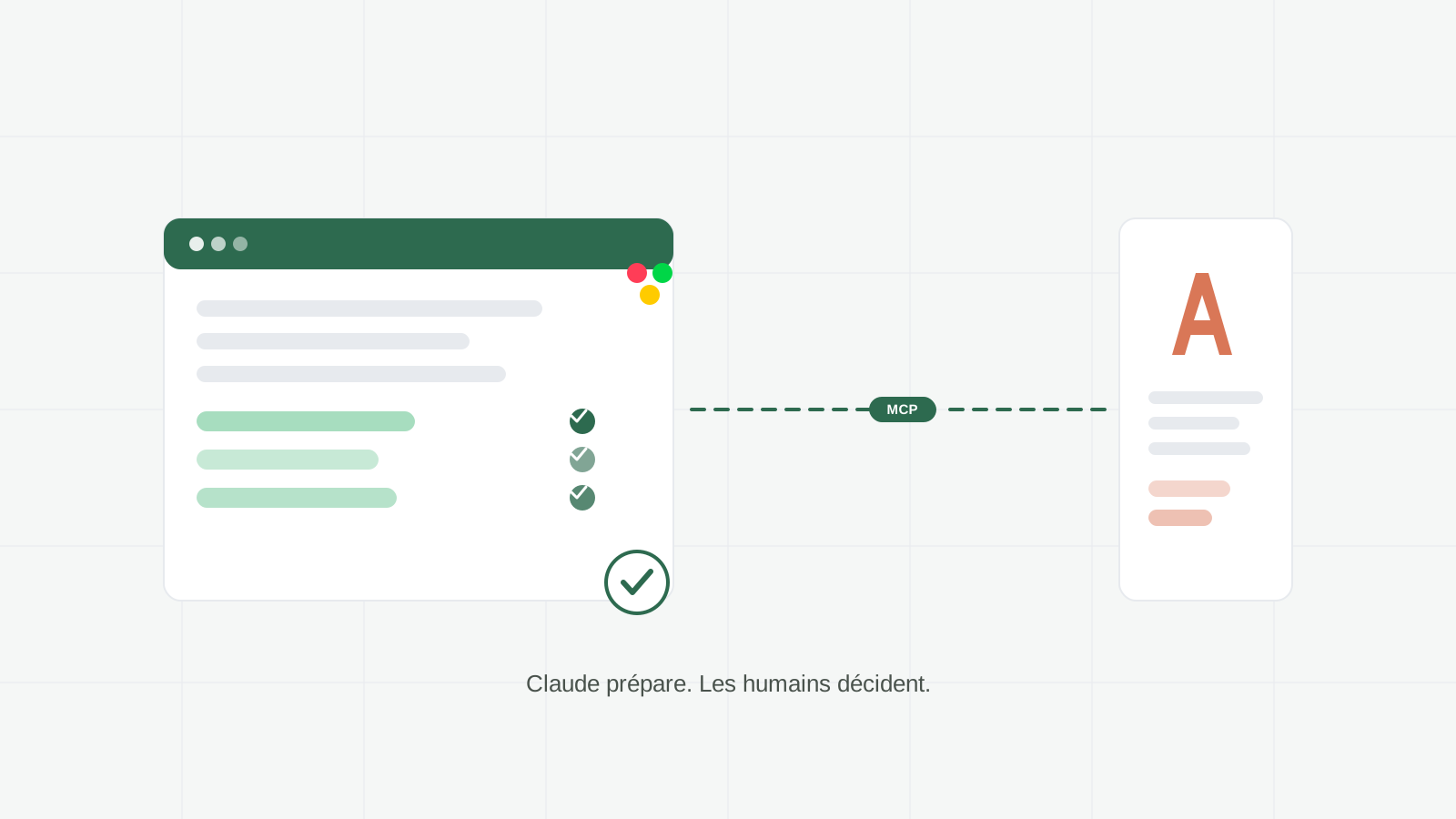
Connecting Claude to monday.com means linking Anthropic's AI directly to your boards through monday.com's MCP server (Model Context Protocol). Claude can then read your real boards, analyze them, draft summaries and prepare files from your live data, with no Excel exports and no copy-pasting into a chatbot. The ground rule does not change: AI prepares the work, humans decide.
What this article explains: what the Claude and monday.com connection concretely is, what it changes in a construction company or materials manufacturer, what it is not, and how to start it properly.
Until now, the common reflex looked like this: export a board to Excel, paste the file into a chatbot, ask for a summary, then retype the output into emails and spreadsheets. It works, but the data goes stale, the context gets lost, and every analysis starts from scratch. monday.com's MCP server fixes exactly that problem: it gives Claude direct, structured access to your boards, up to date, with their full context.
What it concretely changes
Three typical scenarios from construction and from the materials and component manufacturing serving its jobsites. They illustrate the mechanism, they are not client results: yours will depend on your own processes and data.
Bid follow-ups (construction)
Before: the project manager opens the bids board, exports a view, pastes it into a chatbot, asks which bids have gone quiet, then writes each follow-up email by hand, one by one.
After: Claude reads the bids board directly. It flags files with no movement in ten days, prepares the follow-up list and drafts an email for each one, with the client name, amount and sent date already in place. The project manager reviews, adjusts the tone, sends. They decide who gets a follow-up, and when.
Site progress summaries (construction)
Before: ahead of the weekly meeting, someone spends 45 minutes digging through updates, photos and comments to write a coherent progress note.
After: Claude walks the project board, the latest updates and the blocked items, then prepares a structured summary: progress by phase, open risks, decisions needed this week. The site supervisor checks the numbers and adds judgment. The meeting starts from a current base instead of a rushed document. In construction businesses, this is often where preparation time drops the fastest.
Production status and invoice preparation (construction materials manufacturing)
Before: every Friday, the coordinator cross-references the production board with materials orders delivered to jobsites to figure out what to invoice, line by line, by hand.
After: Claude reads live production status, identifies orders completed and delivered to the jobsite, then prepares the list of invoices with amounts and references already associated in monday.com. The coordinator checks every line before anything goes to accounting.
What it is not
Let's be direct, because the topic attracts misunderstandings.
It is not a chatbot gimmick. The difference is not "one more bot": it is that AI works on real, current data, in the board's context, instead of a frozen excerpt pasted into a window. When the board moves, the analysis follows.
It is not an autopilot. Claude does not send follow-ups on its own, does not approve a price, does not commit to a deadline with a customer. Every commitment, every approval, every amount stays a human decision. If a vendor promises you otherwise, ask them hard questions.
It is not a team replacement. The connection removes compilation and preparation time. It does not remove the site supervisor's experience, the coordinator's judgment, or the customer relationship. It gives those people their time back for the work that actually needs their expertise.
The natural stack: Sidekick, AI Agents, monday workflows and Claude
Connected Claude does not replace monday.com's native AI: it completes it. Each layer has its role, and a good configuration uses them together.
- Sidekick: the everyday assistant. Quick questions on a board, on-demand summaries, one-off help without leaving monday.com.
- monday workflows: the AI blocks inside your automations. Classify a request, extract a piece of information, draft an update, all triggered by your processes.
- AI Agents: the autonomous sequences. Chains of steps that sort, assemble and prepare work while the team keeps the decisions.
- Claude connected via MCP: deeper analysis and writing on your real data. Long syntheses, complex files, document preparation that needs depth.
The simple rule of thumb: native layers for what gets triggered and executed inside monday.com, connected Claude for what needs broad reading and careful writing. This is exactly the stack we configure in our AI automation engagements. Our own tools, like Horizon Clock for time tracking and OCR by Horizon for document reading, are available exclusively with Direction by Horizon: they feed the same boards Claude can then analyze.
How a sane implementation starts
The order of the steps matters more than speed. A Claude connection plugged into poorly structured boards only produces summaries of poorly structured boards.
- Map the processes first. Before connecting anything, we map how information moves: who enters what, where, when, and which decisions follow.
- Configure on real files, with the real words. Statuses, columns and templates use your team's vocabulary, not a generic template's.
- Connect Claude where preparation is expensive. One use case at a time: bid follow-ups, site summaries, invoice preparation. Measure, adjust, extend.
- Keep every commitment human. Prices, approvals, promises to customers: never delegated to AI, even when the draft is good.
That is exactly what a first conversation with us covers. In 45 minutes, no commitment, we look at your processes and identify the first place where Claude connected to monday.com would save you real time. Discuss your operations.
Frequently asked questions
Can Claude modify my monday.com boards?
In a sane configuration, Claude reads your real data and prepares the work: summaries, drafts, files. Actions that commit your business, like sending a follow-up or approving a price, stay validated by your team. That principle guides every configuration we ship.
Do you need a large team to connect Claude to monday.com?
No. An SMB with clear processes benefits just as much as a large organization, often faster. The prerequisite is not size: it is a well-structured board and one precise use case.
What is the difference between Sidekick, AI Agents and connected Claude?
Sidekick is the built-in everyday assistant in monday.com. AI Agents run autonomous preparation sequences. Claude connected through the MCP server adds a deeper analysis and writing layer on your real data. The three complement each other.
Where do we concretely start?
With process mapping, not technology. Once the first use case is identified, the connection is configured on your real files, in your team's words, and every committing decision stays human.
