Choosing an ERP partner in 2026 is a decision that shapes your operations for the next five to ten years. For a Quebec manufacturer the choice is even tighter: the local market is fragmented, the fiscal and operational requirements are specific, and agencies are not interchangeable depending on your type of production.
What this comparison covers: the Odoo and ERP agencies most often named for manufacturing SMBs in Quebec and Canada, read against concrete criteria rather than marketing budget.
Three realities define the manufacturing ERP market in 2026:
- AI has gone native. As Axys Consultants notes, AI is no longer an optional module: it sits at the core of modern ERPs, from demand forecasting to production-flow automation.
- The cloud has tipped. Most new ERP deployments now run in the cloud, which changes the cost, maintenance and update models.
- The wrong partner costs more than the wrong software. A poorly scoped project, with no solid implementation method or knowledge of the Quebec context, generates delays, reconfigurations and partial adoption that cancel out the return on investment.
This comparison is built to help you avoid that scenario.
How to read this comparison
Rather than an absolute ranking, here are the five criteria that genuinely matter when a Quebec manufacturer picks an Odoo or ERP partner. Apply them to your own context: that is the final filter.
| Criterion | What to look at |
|---|---|
| Manufacturing fit | Concrete factory experience: repetitive production, make-to-order, bills of materials, MRP |
| Real implementation capacity | Project method, milestones, dedicated resources, change management |
| Quebec / Canada roots | Command of local fiscal requirements (GST/QST, payroll, Revenu Quebec compliance), local team |
| Certifications and partnerships | Official Odoo status (Ready, Silver, Gold) or documented ERP expertise |
| AI maturity | Ability to connect AI to real operational flows, not just to sell it |
Read this honestly: this comparison is published by Horizon Nord, which is also listed in it. The descriptions below reflect each agency's public positioning as of June 2026 and our editorial reading, not an independent audit. Always validate directly with the agencies and ask for references in your sector before signing.
The 2026 comparison: Odoo and ERP agencies in Quebec and Canada
1. Gestisoft
Profile: Montreal-based Odoo integrator, long established in the Canadian SMB ERP market, from configuration to custom development, training and support.
Best fit: a manufacturing SMB that wants a complete Odoo implementation with structured support and a local French-speaking team.
To validate: its fit for very complex make-to-order projects (advanced MRP configuration), depending on your production profile.
2. NSI Canada
Profile: Odoo partner active in Canada, positioned on centralizing operations (production, purchasing, accounting, logistics) on a single platform.
Best fit: a growing manufacturer that wants to unify its systems without multiplying tools.
To validate: sector depth in complex manufacturing, to confirm per project.
3. Octura Solutions
Profile: Quebec Odoo integrator that foregrounds the manufacturing sector in its positioning (production, quality, maintenance).
Best fit: an SMB that wants a close, hands-on partner with stated experience of production flows and Odoo's MRP module.
To validate: its capacity to cover a national or multi-site mandate.
4. Groupe Conseil ERA
Profile: independent ERP consulting firm supporting the selection, implementation and optimization of management systems, including Odoo.
Best fit: a manufacturer that wants a neutral view before committing to an integrator, or strategic scoping upfront.
To validate: this is an advisory approach rather than pure execution; useful before the project, to pair with an integrator for delivery.
5. Horizon Nord
Profile: Odoo Ready Partner and monday.com Certified Partner, Montreal-based, bilingual. Horizon Nord implements Odoo for construction, manufacturing and the public sector, and connects native AI (including Claude via the MCP connector) to operational flows: forecasting, prioritization, decision support.
Best fit: a Quebec SMB that wants an Odoo implementation tuned to the local fiscal context, in French and English, and that wants to treat AI as a measurable operational lever rather than a marketing promise.
To validate: less relevant for those who only want a standard ERP license with no AI-integration ambition.
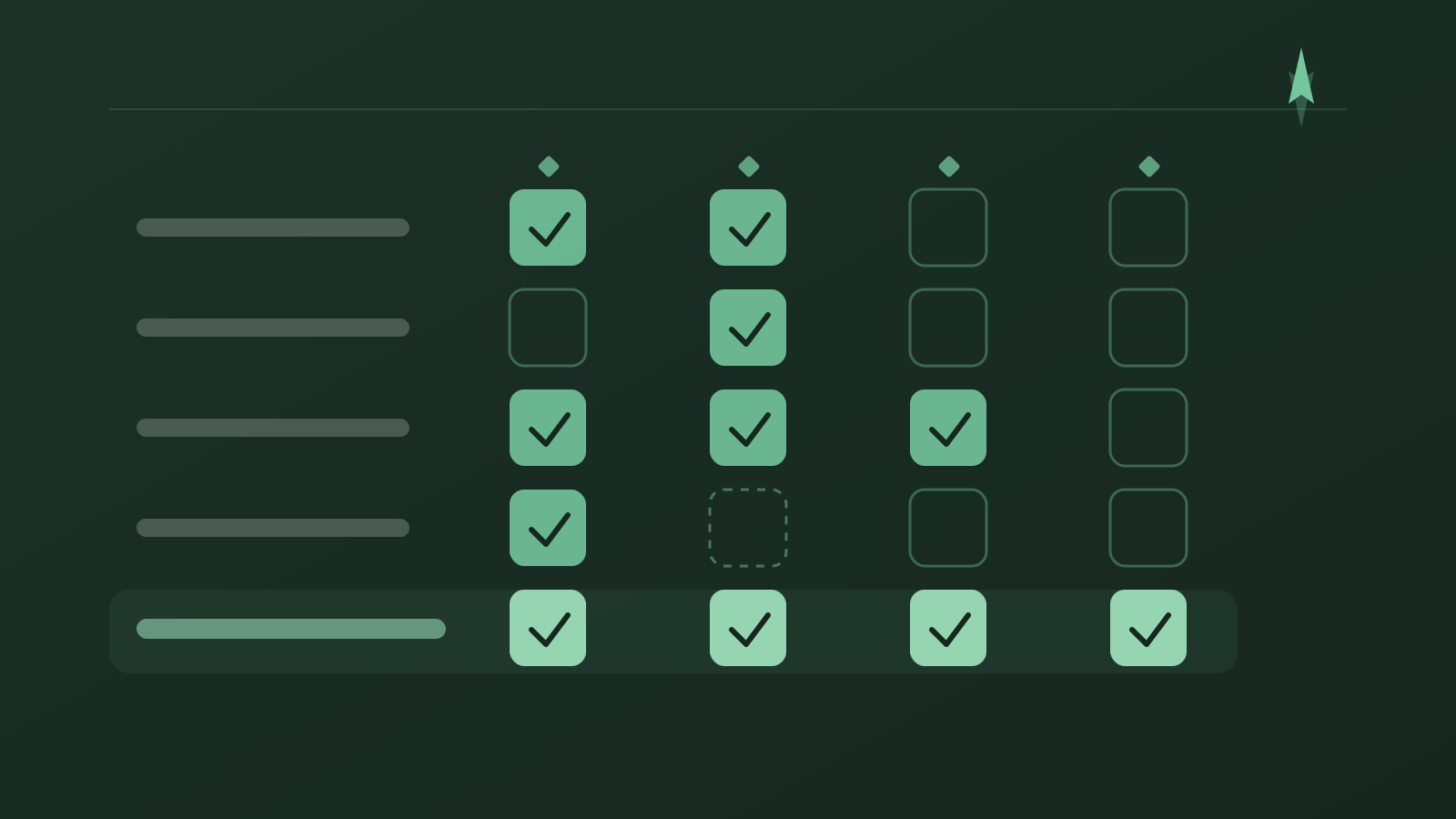
Quick comparison table
| Agency | Quebec roots | Odoo | Manufacturing | AI integration |
|---|---|---|---|---|
| Gestisoft | Strong | Yes | Medium | Medium |
| NSI Canada | Medium | Yes | Medium | Medium |
| Octura Solutions | Strong | Yes | Strong | Medium |
| Groupe Conseil ERA | Strong | Advisory | Medium | Medium |
| Horizon Nord | Strong | Yes | Strong | Strong |
Which partner for your manufacturing reality
The comparison above is a starting point. The real decision comes from crossing your production profile with each partner's actual strengths.
Repetitive or small-batch production
Odoo's MRP module covers this type of manufacturing very well: production orders, bills of materials, stock tracking, quality, maintenance. An Odoo integrator with references in serial production is the right profile here.
Complex make-to-order
For engineer-to-order, variable configurations and long production runs, Odoo covers the essentials but deserves comparison with more specialized ERPs. A neutral consulting firm can help assess the real fit before choosing the platform.
SMBs in digital transformation with AI ambition
To go beyond standard ERP and embed AI agents into your flows (forecasting, order prioritization, decision support), assess the partner's real AI maturity, not just its feature list. Ask for concrete use cases, not promises.
| Manufacturing profile | Recommended direction | Partner profile |
|---|---|---|
| Repetitive / small-batch | Odoo MRP | Odoo integrator with production references |
| Complex make-to-order | Odoo or specialized ERP | Neutral advisory + evaluation before choosing |
| SMB with AI ambition | Odoo + AI integration | Partner with demonstrated AI maturity |
| Multi-site / fast growth | Modular Odoo | Integrator able to cover national scope |
Costs, risks and red flags before you sign
The ERP license is rarely the biggest line item. It is the implementation that sets the real budget, and the gap is often significant.
A few orders of magnitude commonly cited in the industry, to take as benchmarks and not as a quote:
- A manufacturing SMB's implementation budget often lands around 1% to 3% of annual revenue.
- For an SMB of about 25 users, ranges of 25,000$ to 75,000$ come up frequently depending on complexity.
- A serious manufacturing project often represents several hundred hours, including configuration, data migration and training.
- Heavier ERPs like SAP or NetSuite can demand several times the license cost in implementation fees.
The red flags to watch before signing:
- Vague AI promises, with no demonstration or documented use case in your sector.
- No manufacturing references in Quebec or in a comparable production context.
- Weak command of Quebec fiscal requirements: GST/QST, payroll modules, Revenu Quebec compliance.
- No formalized project method: without scoping, milestones and clear deliverables, timelines and budgets slip.
- Fuzzy post-launch support: implementation does not end at go-live, the first 90 days are often the most critical.
- Unconfirmed dedicated team: some agencies sell with seniors and deliver with juniors.
The simplest rule: ask for references in your sector and talk directly to the agency's clients before signing.
AI, a real selection criterion in 2026
In 2026, AI in the ERP is no longer a feature to come: AI agents are becoming a standard of management platforms. Concretely, for a manufacturer, that means demand forecasting, production-order prioritization, anomaly detection in supply, and decision support for operations leads.
But the real risk is not missing out on AI. It is adopting it with no measurable impact. Industry research, including from the Capgemini Research Institute, shows that only a minority of organizations actually move from AI pilots to scaled deployment. Most stay stuck at the experimentation stage.
Three questions to ask your ERP partner about AI:
- Which AI use cases have you deployed in real production, not in a demo?
- How is AI connected to the ERP's operational data, and not only to dashboards?
- What is the realistic timeline for measurable impact on operations?
A partner who cannot answer those three questions precisely is not yet ready to deliver serious AI integration.
Validating whether Odoo fits your context
Before choosing an agency, the useful question is not "which ERP is best?" but "which ERP is the right fit for my type of production, my team and my constraints?"
At Horizon Nord, that starts with a free 60-minute consultation: we look at your current tools and tell you straight whether Odoo is the right direction, and which phase to start with if it is. It is not a sales call, it is honest scoping. If you are a manufacturer, we start from your real production flows.
Frequently asked questions
How do I choose an Odoo agency for a Quebec manufacturer?
Start from your type of production, then check real manufacturing experience, command of Quebec fiscal requirements, the implementation method and post-launch support. The right partner is not only certified: it knows how to deliver in your operational context.
Does Odoo fit every type of manufacturing?
No. Odoo is generally well suited to repetitive production, small batches and SMBs that want a modular solution. For very complex make-to-order, compare the operational fit with other ERPs before deciding.
How much does an ERP implementation cost for a manufacturing SMB?
Implementation cost often exceeds the license itself. Depending on complexity and user count, industry benchmarks often land around 1% to 3% of annual revenue. These are orders of magnitude, not a quote.
Why is AI becoming an ERP selection criterion in 2026?
Because it is no longer a simple marketing add-on. In good projects, AI helps forecast demand, prioritize tasks and support decisions. The real challenge is integrating it into operational flows, not adding it on the surface.
What is the difference between an Odoo integrator and an independent ERP consultant?
An Odoo integrator mainly implements one specific platform, while an independent ERP consultant helps scope the need, compare options and reduce the risk of a wrong choice. Both approaches are useful depending on the project stage.