
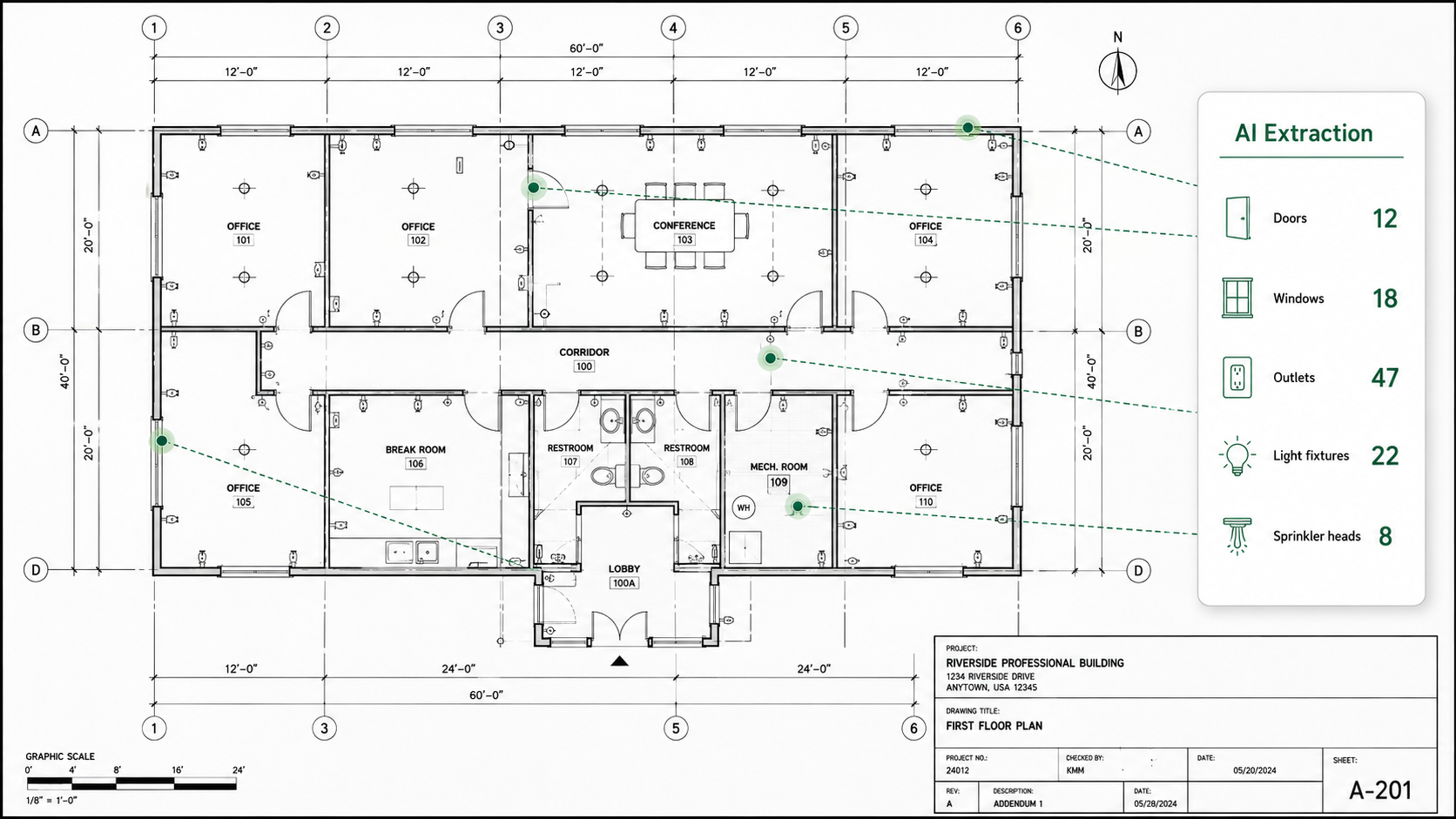
A Quebec contractor told us this last week. He receives an invitation to bid on Tuesday evening. The submission is due Friday morning. The drawing set is 84 pages. To produce a serious price, his estimator will spend between 18 and 25 hours on it. Read every sheet, count linear feet, identify technical details, build the quantity takeoff, finalize a number.
Multiply by 30, 50, 80 bids per year. That's where automated blueprint reading starts to look interesting.
We get this question often: "Can your AI read my plans?" The honest answer is yes, with important caveats. Here's what AI-driven blueprint reading can do in 2026, and where it still stumbles.
What AI extracts well today
Vision models (Claude Sonnet 4.6, GPT-4 Vision, Gemini 2 Pro) have made a significant leap on technical documents since 2024. Three families of data come out particularly clean.
Material lists and quantity schedules
A typical architectural drawing set includes tables: doors, windows, finishes, equipment. AI reads these tables with high accuracy (90-95% on clean drawings), produces a structured file (CSV, JSON), and pushes it directly into your estimating system or your monday.com board.
General notes and annotations
All the notes scattered on the drawings (building code references, special requirements, references to specifications) get extracted and categorized. Useful for making sure you don't miss an owner-specific requirement hiding in the corner of sheet A-201.
Repeatable countable elements
Counting electrical outlets, plumbing fixtures, sprinkler heads, light fixtures on a floor plan. With a well-built prompt and proper calibration, AI delivers a count reliable to within plus or minus 5%. As an estimating starting point, that's valuable.
What AI doesn't do well
Technical honesty means naming the limits.
Measuring linear lengths precisely
AI can estimate, but it doesn't autonomously calibrate the scale of a digitized drawing. If you need measurements accurate to the inch (partitions, ductwork, piping), you need either a specialized tool (Bluebeam, PlanSwift) or a human who validates.
Reading handwritten or redrawn plans
Field sketches, pencil annotations, shop details drawn by hand: generalist AI gets lost. For those cases, you go back to humans or to a highly specialized OCR.
Understanding sections and 3D details
An elevation, a vertical section, an isometric detail: AI sees the lines, but it doesn't reconstruct the building in its head. It can describe what it sees, not infer what isn't drawn.
The workflow we deploy with clients
For a specialty contractor pricing 40 to 80 bids per year, here's the chain we typically set up.
PDF drops into monday.com or Odoo
The estimator places the drawing set in the project board. An automation triggers processing, no extra click required.
AI extraction page by page
An agent (usually Claude Sonnet 4.6, connected via MCP) identifies tables, extracts notes, makes a first count of repeatable elements. Output lands in the monday.com board, one column per category.
Estimator validation
The estimator opens the board and works from an already-structured foundation. Validates sensitive quantities, adjusts approximations, adds field judgment. Mechanical reading drops from 20 hours to about 4.
Export to the estimating module
The board pushes directly into BidScreen, ProEst, or an in-house spreadsheet. The price comes out. The bid goes out.
Questions to ask before diving in
AI applied to blueprints is not a magic button. Before investing in an automated extraction chain, three questions are worth asking.
How many bids per year?
Below 20, the return on investment is thin. Above 40, it starts to make solid sense.
What's the quality of the plans you receive?
Clean vector PDFs from professional architects: excellent ground. Photos of rolled drawings, scanned crooked, with marker annotations: rougher ground.
Do you already have a central system (monday.com, Odoo, something else)?
Without a clear destination for the extracted data, AI just produces noise. The value shows up when extraction plugs into your existing flow.
Where it's heading
Vision models keep improving. Microsoft announced at BUILD 2026 that Foundry IQ will include a module specialized for construction technical documents, expected by year-end. Anthropic and OpenAI are working on versions of their models specifically trained on CAD drawings. Within 12 to 18 months, precision on measurements and sections will likely take another leap.
For today, the right angle is to start with the elements AI already handles well (tables, notes, simple counts), build a chain that delivers part of the estimate, and keep the human in the loop for judgment calls.
This is exactly the kind of project we scope in a first conversation. If you want to see what it would look like with your real plans, let's talk.